5 Prompting Styles for LLMs Every Developer Should Know

Prompt engineering is the art of getting the best out of large language models (LLMs) like GPT-4 or Gemini. Whether you’re building a chatbot, coding assistant, or an AI judge, the way you “talk” to your model matters—a lot!
In this article, I’ll walk you through five essential prompting styles, with practical JavaScript-flavored examples and tips for each.
Please refer to this GitHub repo for better understanding: Repo Link
1. Zero-Shot Prompting

What is it?
You give the model a task with no examples—just clear instructions.
When to use:
The task is simple or well-known.
You want to see how the model handles things “cold.”
Example:
// System prompt:
"You're an AI assistant who only answers JavaScript coding questions.
If asked anything else, politely refuse."

// User:
"Hey, what's my name?"
2. Few-Shot Prompting
What is it?

You show the model a few Q&A examples before your real question.
When to use:
You want to steer the model’s style or logic.
The task is ambiguous or nuanced.
Example:
// System prompt includes examples:
"Q: I am bored
A: What about a JS Quiz?

Q: Can you write Python code?
A: I can, but I'm designed to help in JS."

// User:
"Can you help me with JavaScript?"
3. Chain-of-Thought Prompting
What is it?
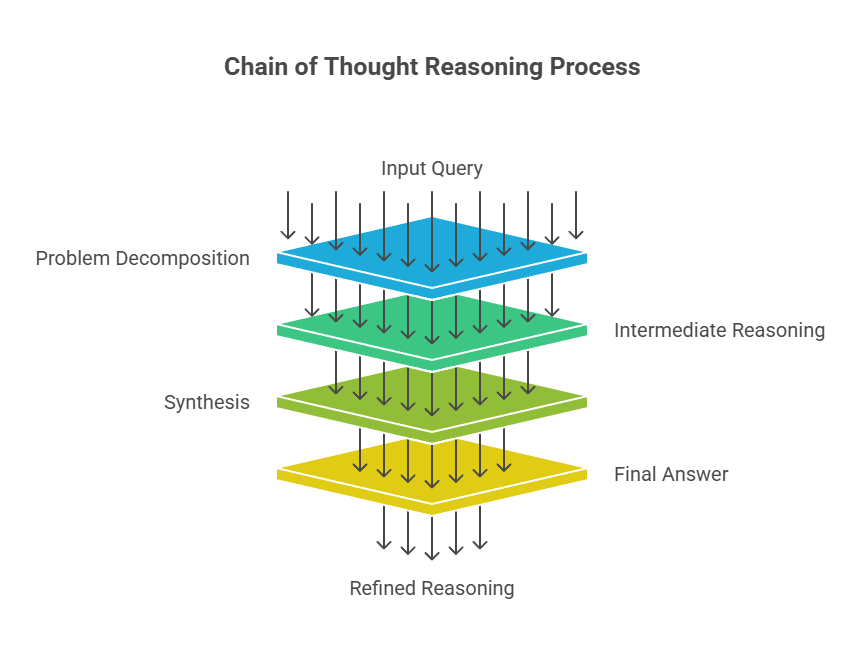
You encourage the model to “think out loud,” breaking down its reasoning step by step.
When to use:
The task is complex or multi-step.
You want transparency in the model’s reasoning.
Example:
// System prompt:
"Answer in steps: START, THINK, OUTPUT. For each step, explain your reasoning before giving the final answer."

// User:
"Write a JS function to check if a number is prime."
The model might reply:
START: "The user wants a JS function to check for primes."
THINK: "I'll loop from 2 to sqrt(n) and check divisibility."
OUTPUT: "function isPrime(n) { ... }"
4. Self-Consistency
What is it?

You generate multiple answers, then use another model (or the same one) to pick the best.
When to use:
You want more reliable or creative outputs.
The task is subjective or open-ended.
Example:
Ask two models (or the same model twice):
“Write a small JS program to add two numbers.”Feed both answers to a “judge” prompt:
“Which of these is the best answer? Return only the correct response.”
This helps filter out mistakes or bland responses.
5. LLM-as-a-Judge
What is it?

You use an LLM to evaluate or critique another model’s answer or reasoning.
When to use:
You want automated feedback or validation.
You’re building a multi-agent system.
Example:
Model A explains its reasoning step.
Model B (the judge) is prompted:
“Is this reasoning correct? Reply with ‘Correct’ or ‘Incorrect’ and a brief explanation.”
This is great for building AI tutors or automated code reviewers.
Final Thoughts
Prompting is more than just asking questions—it’s about guiding, teaching, and sometimes even challenging your AI. Try mixing these styles in your next project, and you’ll be amazed at how much more useful (and fun!) your LLMs become.
Which prompting style are you most excited to try? Let me know in the comments!


